
17
2019
-
10
State Food and Drug Administration: medical device coding date, variety officially released.
The official draft was released on October 15 (draft for comments on September 17), the implementation date and some contents were revised, and the notice of medical device coding was officially issued.
Attached at the end of the article is a catalogue of 64 varieties in the official version.
Work schedule issued
On October 15, the official website of the State Food and Drug Administration issued a notice on matters related to the implementation of the first batch of unique identification of medical devices.
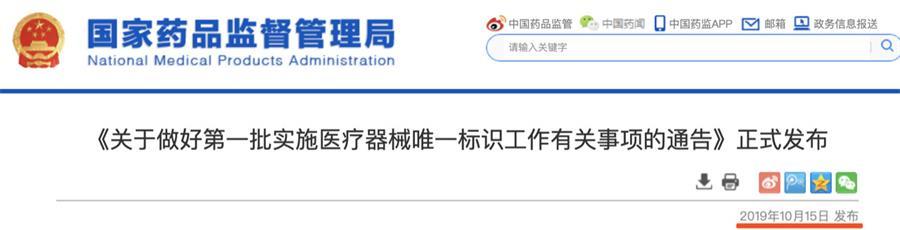
Prior to this, the State Food and Drug Administration issued a draft for soliciting opinions on the requirement. After revision, the confirmed "Notice" clearly stipulated the scope, schedule and work requirements of the first batch of medical device unique identification.
It is important to note that the execution date has also been changed.
Step-by-step implementation of the unique identification system for medical devices
Variety range: according to the degree of risk and regulatory needs, determine some active implantation, passive implantation and other high-risk third-class medical devices as the first batch of medical devices to identify the implementation of the only variety.
Sixty-four varieties of nine categories, including cardiac pacemakers, hip prostheses, and plastic injection fillers, were included in the first batch of product catalogs that implemented the unique identification of medical devices (see the attachment at the end of the specific product catalog).
The schedule is:
The date of the draft is August 2020, and the official version is delayed by 2 months.
For medical devices listed in the first batch of implementation product catalogues, the registrant shall carry out the following work in an orderly manner in accordance with the time limit requirements:
(I) unique identification code
From October 1, 2020, the production of medical devices should have a unique identification of medical devices;
Medical devices produced before October 1, 2020 may not have a unique identification of medical devices. The date of manufacture is subject to the medical device label.
(II) unique identification registration system submission
From October 1, 2020, when applying for first registration, renewal of registration or change of registration, the registration applicant/registrant shall submit the product identification of its minimum sales unit in the registration management system.
Product identification does not belong to the registration review, and the individual change of product identification does not belong to the scope of registration change.
(III) Unique Identity Database Commit
For medical devices produced from October 1, 2020, the registrant shall upload the product identification and related data of the minimum sales unit and higher level packaging to the medical device unique identification database in accordance with the relevant standards or specifications before they are put on the market for sale;
When the relevant data of the product identification of the minimum sales unit of the medical device product changes, the registrant shall make changes in the unique identification database of the medical device before the product is sold on the market to achieve data update.
When the product identification of the minimum sales unit of medical devices changes, the data shall be uploaded to the unique identification database of medical devices according to the new product identification.
What should a company do?
For enterprises, the first batch of registrants who implement unique identification work should attach great importance to it, fully understand the importance of the implementation of the Rules, and organize coding, data uploading and maintenance in strict accordance with the Rules and the requirements of this notice. And responsible for the authenticity, accuracy and completeness of the data.
The requirement for registrants is to encourage registrants to use the unique identification of medical devices to establish an information traceability system for medical devices, so as to realize the traceability of the whole process of production, circulation and use of their products.
Encourage medical device production and operation enterprises and users to actively apply the unique identification of medical devices in their related management activities, explore the establishment of a traceability chain with upstream and downstream, and promote the connection and application.
Training of the "Rules" should be carried out, targeted business training should be carried out for registrants, production and operation enterprises, and user units, organize relevant personnel to learn, and strengthen work guidance and implementation.
What is the role of the system and unique identification?
According to August 27, the State Food and Drug Administration issued the "rules for the unique identification system of medical devices", the unique identification system of medical devices consists of the unique identification of medical devices, the unique identification data carrier and the unique identification database.
The unique identification of a medical device refers to the code consisting of numbers, letters or symbols attached to the product or package of the medical device, which is used to uniquely identify the medical device.
The unique identification data carrier of the medical device refers to the data medium for storing or transmitting the unique identification of the medical device.
The medical device unique identification database refers to the database that stores the product identification and associated information of the medical device unique identification.
The unique identification of the medical device includes a product identification and a production identification.
The product identification is a unique code that identifies the registrant/filer, the model, specification and packaging of the medical device; the production identification consists of the code of the information related to the production process of the medical device, and may include the serial number, production batch number, production date, expiration date, etc. of the medical device according to regulatory and practical application requirements.
At the same time, the Rules require that the unique identification of medical devices should meet the requirements of uniqueness, stability and scalability.
Uniqueness means that the unique identification of the medical device shall be consistent with the identification requirements of the medical device.
Stability means that the unique identification of the medical device shall be related to the basic characteristics of the product, and if the basic characteristics of the product remain unchanged, the product identification shall remain unchanged.
Scalability means that the unique identification of medical devices should be compatible with the continuous development of regulatory requirements and practical applications.
In addition, the unique identification data carrier of medical devices should meet the requirements of automatic identification and data collection technology and manual reading. If space is limited or use is limited, the carrier form that conforms to the automatic identification and data collection technology should be preferred.
Automatic identification and data acquisition technologies include one-dimensional codes, two-dimensional codes or radio frequency tags, and the use of advanced automatic identification and data acquisition technologies is encouraged.
When using one-dimensional code, the product identification and production identification can be connected in series, or multiple lines can be connected in parallel; when using radio frequency tags, one-dimensional code or two-dimensional code should be available at the same time.
More information
Contact Us
after-sales service hotline
Mailbox:hr_gdrfyf@126.com
Address: Gedian Economic and Technological Development Zone, Ezhou City, Hubei Province
Social Media
Support Ipv6/Ipv4 bidirectional access
SAF Coolest v1.3 设置面板 YAUSX-ZTSG-IVAEE-AFF
图片ALT信息: Ge Dian Renfu Medicine Auxiliary
无数据提示
Sorry, the current column has no content for the time being.!
You can view other columns or returnHome Page